
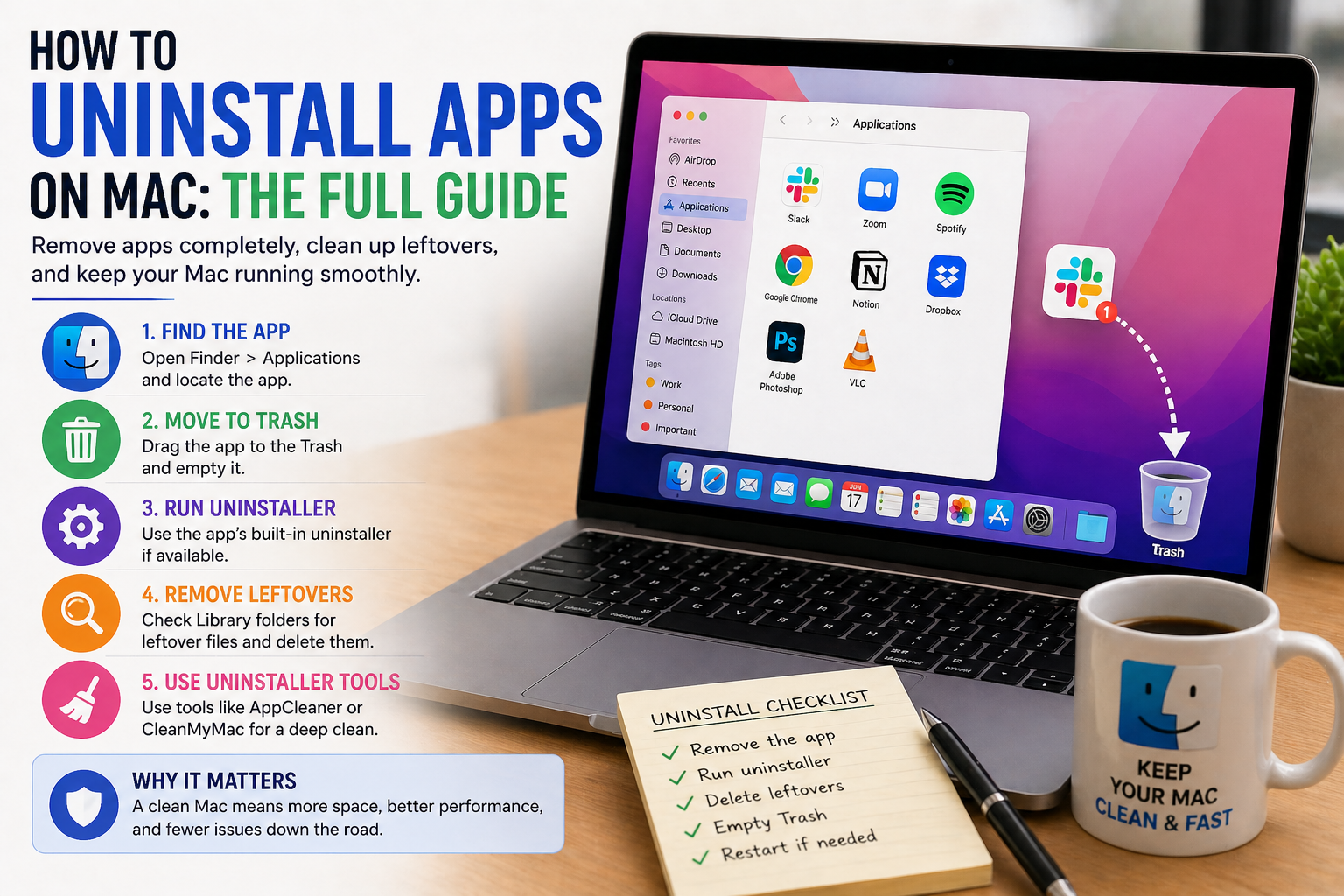
You downloaded the app on a whim.
A free trial. A “must-have” tool. Something a friend insisted would change everything.
It didn’t.
Now it’s just sitting there, taking up space, maybe launching at startup like it pays rent.
So you drag it to the Trash and move on.
But if you’re here searching how to uninstall apps on Mac, you’ve probably noticed something: Mac apps don’t always leave cleanly.
And that’s where things get messy.
Let’s fix it, properly this time.
The Basic Method: Drag, Drop, Done (Sometimes)
Let’s start with what everyone knows.
- Open Finder
- Click Applications
- Find the app
- Drag it to the Trash
- Empty the Trash
For many apps, that works fine. Clean removal. No leftover drama.
But here’s the catch: some apps leave behind fragments, preferences, caches, hidden files, that slowly build up over time.
So yes, this method works.
Just not always completely.
Launchpad Method: Fast, Visual, Limited
Prefer something more visual? Use Launchpad.
- Open Launchpad
- Click and hold an app icon
- Wait for icons to jiggle
- Click the “X”
Done.
Except… this only works for apps downloaded from the App Store.
If there’s no “X,” you’ll need another approach.
The Official Way: Built-In Uninstallers
Some apps don’t like being casually deleted.
Larger programs, think security tools or creative suites, often include their own uninstallers.
Instead of dragging them to Trash:
- Open the app’s folder
- Look for an Uninstall tool
- Follow the steps
Why this matters:
These apps install deeper system components. Removing them incorrectly can leave background services or broken files behind.
And those are much harder to clean up later.
Leftover Files: The Hidden Clutter Problem
This is where most users stop, and where problems begin.
Even after deleting an app, macOS may still keep:
- Preference files
- Cache data
- Application support files
To find them manually:
- Open Finder
- Click Go (top menu)
- Hold Option → Library
- Check folders like:
- Application Support
- Preferences
- Caches
Search for anything related to the app you removed.
Delete carefully.
This is not the place to guess.
Use Uninstaller Tools (If You Value Your Time)
Let’s be honest, manual cleanup isn’t fun.
That’s where third-party tools help.
Popular options include:
- AppCleaner
- CleanMyMac
These tools:
- Scan for leftover files
- Remove everything in one step
- Save you from digging through system folders
Just drag the app into the tool, confirm removal, and you’re done.
Efficient. Clean. Minimal effort.
What You Can’t Remove (And Shouldn’t Try)
Not everything on your Mac is meant to be removed.
System apps like:
- Safari
- Finder
…are built into macOS.
Yes, there are workarounds to remove them.
No, they’re not a good idea.
Messing with system apps can break functionality and cause instability.
Best approach? Leave them alone.
Why Proper Uninstallation Actually Matters
You might be thinking: Do leftover files really matter that much?
Short answer: yes.
Over time, they can:
- Consume storage space
- Slow down system performance
- Cause conflicts with new apps
It’s not immediate. It’s gradual.
Months later, your Mac feels slower, and you don’t know why.
This is often part of the reason.
Advanced Tip: Removing Login Items and Background Processes
Sometimes, uninstalling an app doesn’t stop it from running processes.
Check this:
- Go to System Settings → General → Login Items
- Remove anything related to the deleted app
Also check Activity Monitor for lingering processes.
Because nothing’s more frustrating than uninstalling something that still runs in the background.
Advanced Tip: Resetting Permissions (If Things Get Weird)
Occasionally, leftover files can cause permission issues.
If apps behave strangely after uninstalling others:
- Restart your Mac
- Run Disk Utility → First Aid
- Ensure permissions are intact
This isn’t always necessary, but useful when things feel off.
Common Mistakes (Avoid These)
Let’s save you some trouble.
- Deleting apps from the Dock (only removes shortcuts)
- Forgetting to empty the Trash
- Ignoring leftover files
- Force-removing system apps
- Skipping official uninstallers
Small mistakes. Bigger consequences.
Quick Recap: How to Uninstall Apps on Mac
If you want the clean, complete version:
- Use Finder (drag to Trash) for simple apps
- Use Launchpad for App Store apps
- Use official uninstallers for complex software
- Remove leftover files manually or with tools
- Check login items and background processes
That’s the full system.
Final Thought: A Cleaner Mac Isn’t Just About Space
Uninstalling apps on macOS looks simple.
And sometimes, it is.
But doing it properly?
That’s what keeps your system:
- Fast
- Stable
- Free of weird, hard-to-explain issues
So next time you remove an app, don’t just delete it.
Finish the job.
Frequently Asked Questions (FAQs)
1. Is dragging an app to Trash enough?
For simple apps, yes. But many apps leave behind hidden files that require additional cleanup.
2. How do I remove leftover files safely?
Use Finder’s Library folder or a tool like AppCleaner to locate and delete related files.
3. Can I uninstall system apps on Mac?
Technically yes, but it’s not recommended. It can break system functionality.
4. What’s the easiest way to uninstall apps completely?
Using a dedicated uninstaller tool is the fastest and most reliable method.
5. Why do apps leave files behind?
Because macOS separates app data (preferences, caches) from the app itself to preserve settings, even after deletion.
*This article is for informational purposes only and should not be taken as official legal advice*