
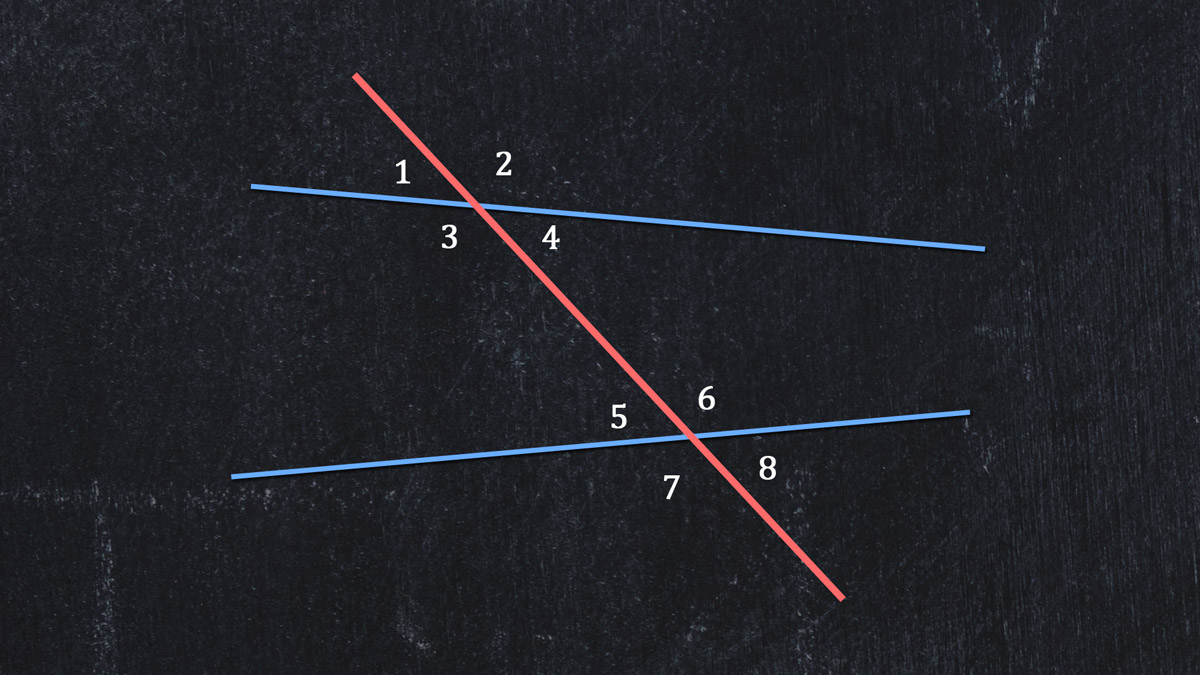
You’re staring at a pair of intersecting lines, trying to remember if those two angles, sitting outside the lines and on opposite sides, are supposed to match. They look like they should. But math doesn’t care about vibes.
So, are alternate exterior angles congruent?
Short answer: yes, when the lines are parallel.
Longer answer: let’s break it down so it actually makes sense (and stays in your brain past the next quiz).
First, What Are Alternate Exterior Angles?
Picture two parallel lines sliced by a third line (called a transversal). This setup creates eight angles in total, some inside the parallel lines, some outside.
Alternate exterior angles are:
- Outside the two parallel lines
- On opposite sides of the transversal
They’re not next to each other. They’re diagonally positioned, like mirror images across the transversal.
So… Are Alternate Exterior Angles Congruent?
Here’s the rule:
Alternate exterior angles are congruent if and only if the lines are parallel.
That means:
- If the lines are parallel → the angles are equal ✔
- If the angles are equal → the lines must be parallel ✔
This works both ways, which makes it especially useful in geometry proofs.
According to foundational geometry principles outlined by sources like the Khan Academy explanation of alternate exterior angles, this relationship is one of the core angle rules tied to parallel lines and transversals.
Why Are They Congruent?
This isn’t just a random rule, it comes from how angles behave when lines are parallel.
Here’s the logic chain:
- Parallel lines create equal corresponding angles
- Corresponding angles relate to vertical angles, which are always equal
- That chain of equalities leads to alternate exterior angles being equal
It’s like a domino effect of angle relationships.
If you want a more formal breakdown, the Wolfram MathWorld entry on alternate exterior angles dives deeper into the geometric reasoning behind it.
What If the Lines Aren’t Parallel?
Here’s where people slip up.
If the lines are not parallel:
- Alternate exterior angles are not guaranteed to be congruent
- They might look equal, but that’s just coincidence
This is actually useful in reverse. If you know the angles are congruent, you can prove the lines are parallel.
That’s a classic move in geometry problems.
Quick Visual Check (Without a Diagram)
No diagram? No problem. Ask yourself:
- Are the angles outside the two lines?
- Are they on opposite sides of the transversal?
- Are the lines parallel (or stated to be)?
If all three are true → they’re congruent.
Common Mistakes to Avoid
Let’s clean up a few misconceptions:
1. Mixing them up with alternate interior angles
Those are inside the parallel lines, but yes, they’re also congruent (under the same condition).
2. Forgetting the “parallel lines” requirement
This is the big one. Without parallel lines, the rule doesn’t apply.
3. Assuming based on appearance
Diagrams can be misleading. Always rely on given information or proven relationships.
Why This Matters Beyond One Question
Understanding whether are alternate exterior angles congruent isn’t just about one geometry rule, it’s part of a bigger toolkit.
You’ll use it to:
- Solve for missing angles
- Prove lines are parallel
- Build multi-step geometric proofs
- Understand real-world designs (architecture, engineering layouts)
Once you get this, a lot of geometry starts feeling less random, and more like a system that actually works.
Final Take
Yes, alternate exterior angles are congruent, but only when the lines are parallel. That condition is everything.
Miss it, and the rule falls apart.
Use it correctly, and it becomes one of the most reliable shortcuts in geometry.
And honestly? It’s one of the few math rules that does exactly what it promises, no tricks, no surprises.
*This article is for informational purposes only and should not be taken as official legal advice*